

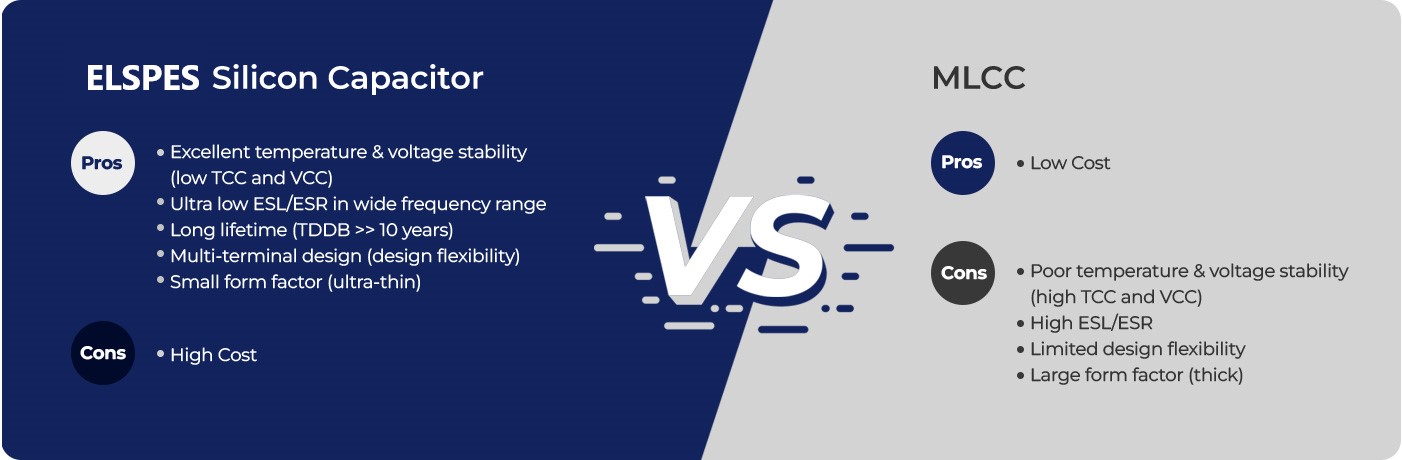
MLCCs, multi-layer ceramic capacitors, are a type of capacitor that is widely used in electronic devices due to their high capacitance values, small size, and low cost. They consist of alternating layers of ceramic material and metal electrodes that are stacked together. MLCCs are commonly used in power supplies, filters, decoupling circuits, and other applications that require high capacitance and low ESR.
However, MLCCs have some limitations that can affect their performance and reliability. One of the main limitations of MLCCs is their voltage derating behavior, which means that the maximum voltage rating of the capacitor decreases as the temperature increases. This can cause the capacitance value to decrease and the ESR to increase, which can lead to reduced performance and reliability in high-temperature applications.
ELSPES silicon capacitors can be used as an alternative to MLCCs. Silicon capacitors offer several advantages over MLCCs, including a lower voltage derating behavior (lower VCC), a higher temperature stability (lower TCC), and a lower ESR and ESL. Silicon capacitors also offer a wider frequency response, which makes them suitable for high-frequency applications.
-
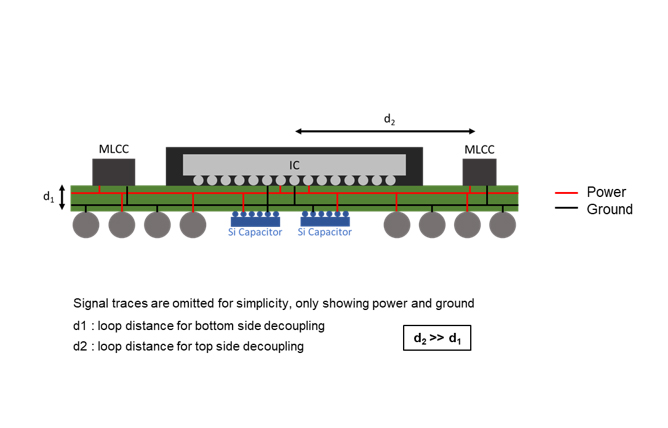
[ Effective Radius Comparison between MLCC and Si Cap ] -
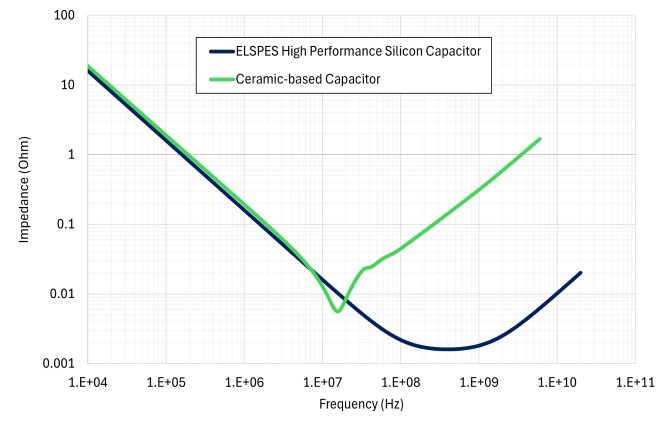
[ Silicon Capacitor vs. Ceramic Capacitors ]
The capacitance change rate of ELSPES silicon capacitor due to changes in temperature and voltage are both significantly lower than that of MLCC, implying that ELSPES silicon capacitor can be used well in extreme temperature from -50°C up to 150°C and can be used in different voltages without any degradation in capacitance value.
By using ELSPES silicon capacitor, with its lower and wider impedance region around self resonance frequency (SRF), smaller number of capacitors is required to meet the target impedance of the application. Along with it, the low ESL of our silicon capacitor also allows 1/16 times ESL value than that of MLCC in the same footprint.
-
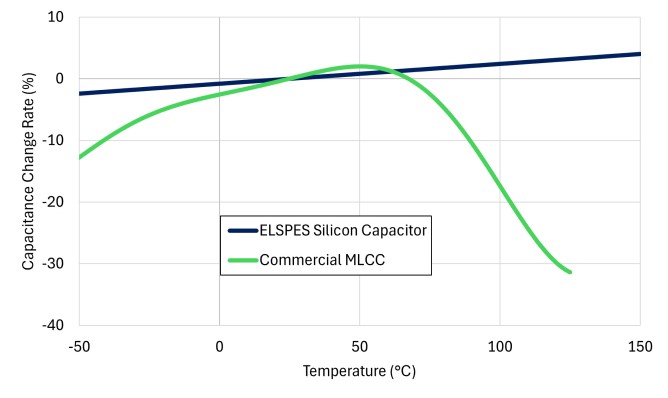
[ Temperature Coefficient of Capacitance ] -
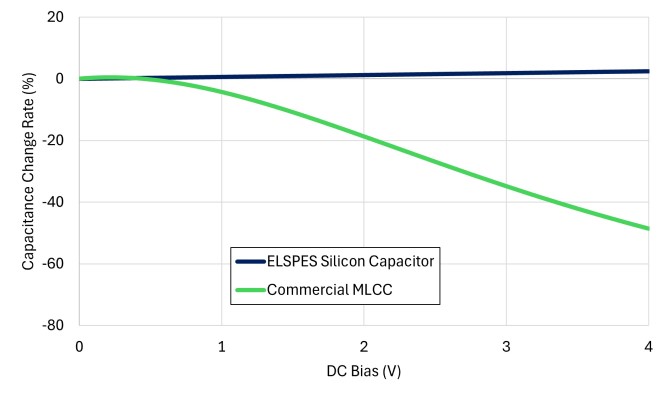
[ Voltage Coefficient of Capacitance ]